English
 Views: 0 Author: Site Editor Publish Time: 2025-12-24 Origin: Site


There is nothing quite as disappointing as craving fresh sushi, ordering takeout, and opening the bag to find a mess. The rice has dried out, the seaweed has become soggy from condensation, or the pieces have slid into one another, mixing flavors that were never meant to meet. For decades, the industry standard has been the black plastic tray with a clear lid. While it gets the job done, it creates massive amounts of waste and doesn't always guarantee the best dining experience.
As consumers demand more sustainable choices, restaurants are moving toward eco-friendly packaging. But this shift raises a critical question for food lovers and business owners alike: Can biodegradable materials actually protect the delicate texture and flavor of raw fish and seasoned rice?
The short answer is yes—but only if the design is right. The days of flimsy cardboard boxes leaking soy sauce are behind us. Innovations like the Sushi Push Pop Tube are proving that you don't need plastic to keep sushi tasting like it just left the chef's hands. By combining smart engineering with food-safe materials, these new containers are changing how we eat on the go.
The biggest enemy of fresh sushi is air exposure and moisture mismanagement. If the container isn't sealed well, the rice hardens. If the material absorbs too much moisture, the roll falls apart. Conversely, if moisture is trapped improperly (as often happens with plastic), bacteria growth accelerates and the nori (seaweed) loses its crispness.
High-quality biodegradable sushi containers solve this through advanced material layering. For example, leading designs utilize a paper-based exterior for structural integrity and sustainability, paired with a specialized interior lining.
According to manufacturing data, the best performers in this category use an interior lining of U.S. FDA-certified aluminum foil. This non-toxic, food-grade material acts as a robust barrier. It prevents the paper tube from absorbing moisture from the rice while simultaneously blocking external air and contaminants. This creates a micro-climate within the tube that maintains the optimal temperature and humidity for sushi, ensuring the taste remains authentic from the restaurant to your door.
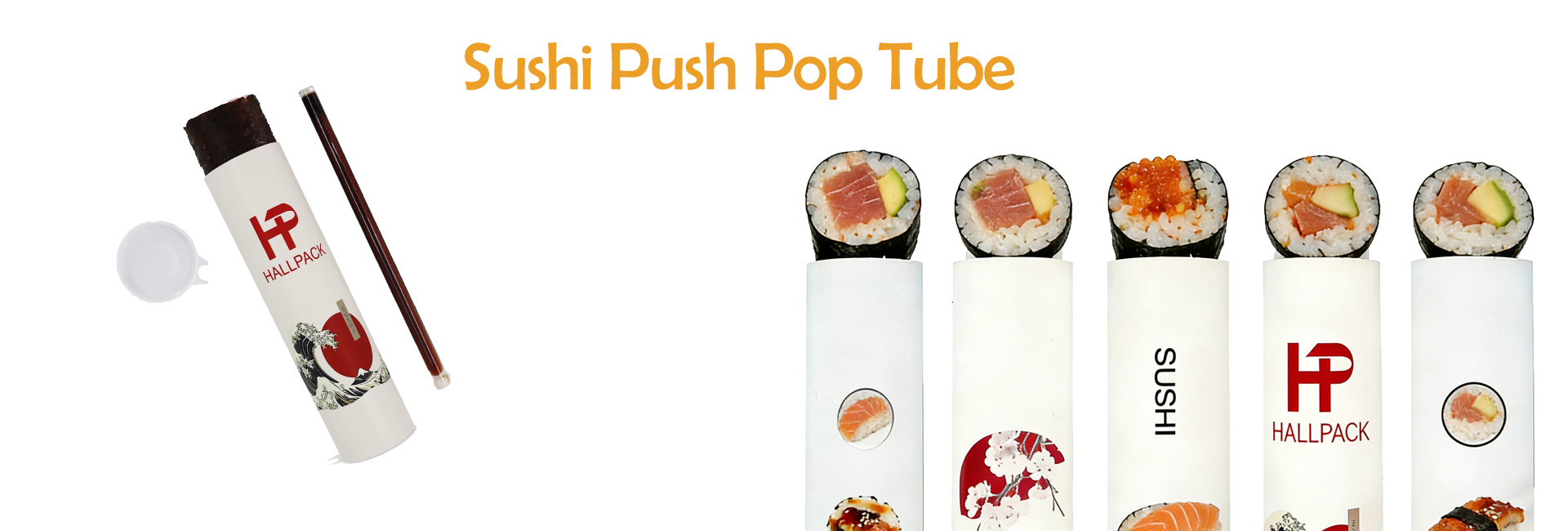
If you are looking for the intersection of freshness, fun, and sustainability, look no further than the Sushi Push Pop Tube. This is not your standard takeaway box. It is a cylindrical, portable design that allows users to eat sushi one bite at a time without ever touching the food.
The structure is ingenious. You simply remove the lid, which often houses a separate compartment for soy sauce, pour the sauce into the designated dispenser, and push the bottom of the tube upward. The sushi rises to the top, ready to be eaten.
This "push-to-enjoy" mechanism does more than just look cool on social media; it protects the food. Because the sushi is stacked vertically and held firmly within the tube, it cannot slide around or tip over during delivery. The pieces retain their shape perfectly, preventing the "squashed sushi" phenomenon that plagues traditional flat trays.
To understand why the shift to biodegradable options is happening, it helps to look at the data. Below is a comparison of traditional plastic packaging against the modern paper tube solution.
Feature | Traditional Plastic Tray | Sushi Push Pop Tube |
|---|---|---|
Material | Petroleum-based plastic | Biodegradable paper & FDA aluminum foil |
Freshness Seal | Often loose; prone to air leaks | Tightly sealed cylinder structure |
Moisture Control | Traps condensation; makes nori soggy | Foil barrier maintains texture |
Transport Stability | Sushi can slide and mix flavors | Vertical stacking prevents movement |
Eco-Impact | High carbon footprint; difficult to recycle | Sustainable; recyclable materials |
Dining Experience | Messy soy sauce packets | Integrated floating sauce dispenser |
Creating a container that is both biodegradable and capable of holding fresh food requires significant manufacturing expertise. One of the leaders in this space is Hallpack(Heshan) Packaging Products Co., Ltd.
Established in 2018 with a founding team possessing over two decades of experience, Hallpack has positioned itself as a premier manufacturer in the premium paper tube packaging sector. They don't just produce standard boxes; they specialize in OEM (Original Equipment Manufacturer) and ODM (Original Design Manufacturer) solutions. This means they can tailor the height, diameter, and print design of the tube to fit specific branding needs.
Hallpack(Heshan) Packaging Products Co., Ltd. operates a modern factory equipped with advanced machinery and over a hundred skilled technicians. Their commitment to quality is evident in their certifications; they offer FSC-certified solutions, ensuring that the paper used comes from responsibly managed forests. For businesses looking to switch to the Sushi Push Pop Tube, Hallpack provides a one-stop service from design to mass production.
You can learn more about their specific sushi packaging solutions here: https://www.hallpack.net/sushi-paper-tube.html
Hygiene is a top priority for raw food. Traditional takeout often involves unwrapping chopsticks, tearing open sauce packets with your teeth, and awkwardly dipping sushi into a shallow plastic well that spills easily.
The tube design minimizes contact. The integrated sauce dispenser means you don't need to pour soy sauce into a separate, unstable lid. The "push" mechanism means you don't even need chopsticks if you don't want them—you can eat directly from the tube. This makes it an ideal solution for outdoor events, cocktail parties, or busy office lunches where washing hands or finding a table isn't always convenient.
While the main structure is paper, high-quality food tubes often use a thin, food-grade lining (like aluminum foil or a biodegradable film) to ensure food safety and moisture resistance. This significantly reduces plastic usage compared to solid plastic trays.
Yes. Manufacturers like Hallpack offer extensive customization. You can adjust the tube height to fit different roll sizes (like maki vs. futomaki) and use full-color CMYK printing to wrap the tube in your restaurant’s branding, logo, and colors.
While the unit cost can be slightly higher than cheap single-use plastic, the value proposition is different. The Sushi Push Pop Tube offers a unique customer experience that can justify a premium price point for the food. Additionally, as regulations against single-use plastics tighten globally, switching now can save businesses from regulatory fines later.
The question isn't just whether biodegradable containers keep sushi fresh—it's whether they can offer a better experience than what we have now. The evidence suggests they can. By utilizing materials like FDA-certified foil linings and smart vertical structures, products like the Sushi Push Pop Tube keep rice moist, fish fresh, and presentation flawless.
For restaurant owners, this is an opportunity to stand out in a crowded delivery market while reducing environmental impact. For consumers, it’s a cleaner, more fun way to enjoy a favorite meal.
If you are ready to explore sustainable packaging that doesn't compromise on quality, it is worth looking into the specialized solutions offered by experts in the field. To see how these tubes can be customized for your business, visit Hallpack(Heshan) Packaging Products Co., Ltd. at https://www.hallpack.net.